
If you spend your time researching ancestors, building family trees, and digging through old records, you already know the power of family history. But what if I told you that the work you’re doing, preserving and sharing family stories, may also help the young people you love build a stronger sense of identity and resilience?
It sounds like a bold claim. But there’s some fascinating research behind it.
It sounds like a bold claim. But the science backs it up. 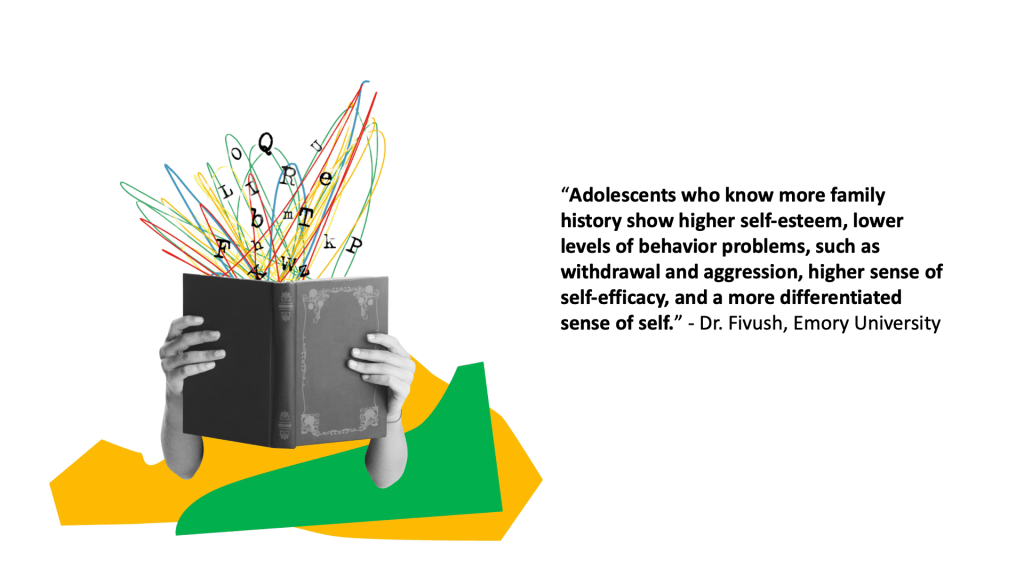
The Crisis Is Real, and It’s Not Slowing Down
I think about a girl I know. At the start of her sophomore year of high school, she began experiencing severe stomach problems: vomiting, inability to keep food down, weight loss. Her mother took her through the entire medical circuit: pediatrician, gastroenterologist, endoscopy. Every test came back the same: your body works just fine. It wasn’t until someone asked whether this might have a mental health component that things began to make sense. It was anxiety. Anxiety this girl had never experienced before, triggered in part by bullying in the school cafeteria.
Her story isn’t unusual. The statistics are staggering. One in five high schoolers has seriously considered suicide (AECF, 2023). Twenty percent of U.S. teens have been diagnosed with a mental or behavioral condition (NCBI, 2023). If you or someone you love is in crisis, call or text 988 to reach the Suicide & Crisis Lifeline, or visit 988lifeline.org.
What’s most alarming is how quickly this crisis accelerated. The iPhone launched in 2007. By 2015, nearly three-quarters of teens had a smartphone; within a few years, that number topped 95%.1 Mental health indicators, rates of anxiety, depression, self-harm, and loneliness, had been mostly flat through the 2000s, then rose sharply around 2011 and 2012, a pattern researchers including Jonathan Haidt have connected to the smartphone era. The effects are more pronounced among girls than boys, but no demographic has been spared.

These are not abstract numbers. They are our children, our grandchildren, our nieces and nephews, the kids in our neighborhoods and congregations.
I think about my daughter’s friend, who has such severe social anxiety that she pulled up to her own graduation party, sat in her car outside, and drove away. She spent her graduation night alone.
As parents, grandparents, aunts, uncles, and people who care deeply about this rising generation, it can feel like there’s nothing we can do. The smartphone isn’t going away. The pressures aren’t easing. It’s easy to feel helpless.
But there is something we can do. And it’s closer than you think.
The Emory Study That Changed Everything
A landmark study from Emory University by Dr. Marshall Duke and Dr. Robyn Fivush found something remarkable. Using a set of twenty questions about family history, now known as the “Do You Know” scale, researchers were able to predict which adolescents would show greater resilience, and which wouldn’t.
The results were striking: “Adolescents who know more family history show higher self-esteem, lower levels of behavior problems such as withdrawal and aggression, higher sense of self-efficacy, and a more differentiated sense of self.”2
In fact, knowledge of family history turned out to be one of the strongest indicators of mental wellness and success in adolescents, more predictive than many factors you might expect.
In short: kids who know their family stories are more resilient. They are more themselves. They are better equipped to handle what life throws at them.
This is the best news possible for those of us who care about family history. We’re already doing the work. We’re already gathering the stories. But what this research tells us is that the simple act of sharing those stories with the rising generation is associated with greater resilience and well-being. And it doesn’t require a research grant or a clinical intervention. It requires twenty questions and a conversation.
Why Does It Work? Biology May Be Part of the Story
The question I kept asking when I first read the Emory study was: why? How is it possible that knowing family stories is associated with greater resilience?
We don’t yet know exactly why. But one fascinating area of research is epigenetics: the study of how cells control gene activity without changing the DNA sequence.
 Think of your genes as a piano and epigenetics as the player. The keys are all there, fixed and unchangeable. But which keys get pressed, which genes are turned on (amplified) or turned off (silenced), can be influenced by your experiences, your environment, your social interactions, your diet, your exercise, and so much more.
A beautiful example from nature is the toadflax flower. A naturally occurring variation can produce flowers with dramatically different symmetry. Researchers discovered that the difference wasn’t caused by a change in the underlying DNA sequence, but by an epigenetic change affecting the activity of a gene involved in flower development.3 Same genetic sequence. Different expression.
The same is true in humans. Identical twins share the exact same DNA, but by adulthood, most can be told apart. Their different experiences have created different epigenetic modifications.
Here’s the key insight: researchers have found that our experiences and environments can influence biological processes, including some involved in how genes are regulated. In other words, our DNA isn’t the whole story. What happens to us matters too.
And here’s where it gets even more interesting. Research on mental imagery has shown that vividly imagining an experience can engage some of the same neural processes involved in actually performing it. Athletes have used this principle for years, mentally rehearsing a swing, a race, or a routine before they ever perform it.
Family stories aren’t the same as athletic visualization, of course. But stories do give us a powerful way to imagine experiences beyond our own. When a young person hears how a parent, grandparent, or ancestor faced uncertainty, failed, adapted, persevered, or changed, they gain another example of what is possible. Over time, those stories can become part of how they understand themselves and their family.
Not Just the Absence of Trauma: The Presence of Something Good
 One more important point from the research: resilience isn’t just about avoiding bad things. As one paper on epigenetics and resilience notes, resilience is “not simply the absence of risk factors, but includes also the influence of protective factors.”4
Family stories are a protective factor. You don’t have to wait for a crisis. You don’t have to fix something that’s broken. You simply have to share.
And there’s something else that can make family stories especially meaningful: connection. When a child hears a story about a parent, grandparent, or ancestor, they’re not hearing about just anyone. They’re hearing about someone who is part of their family and, often, someone with whom they share DNA. A story about a relative who was courageous, persistent, creative, anxious, stubborn, or generous can become a mirror: Maybe that’s part of me, too.
Genetics plays an important role in temperament. One large genetic study identified more than 700 gene locations associated with temperament traits.5
DNA testing companies like 23andMe have also identified hundreds of genetic markers associated with specific traits, everything from eye color to the fear of public speaking.6 This means some of the raw material that shapes who we are is written in our DNA. But genes aren’t destiny. Our experiences, relationships, environments, and choices all play a role in who we become. Family stories can give young people a framework for understanding that inheritance, not as a prescription for who they have to be, but as context for who they might become.
What You Can Do Today
The most impactful stories aren’t necessarily about distant ancestors. They’re about you. Your children share 50% of your DNA. Your grandchildren share 25%. When you tell a story about your own life, about a trait you inherited, a moment you felt most alive, a time you lived your gift or your shadow, you’re not just sharing a memory. You’re providing a mirror that helps them see themselves, understand their own raw material, and decide who they want to become.
Start small. Think about the traits you see in yourself, the things that feel like they’re just you, the way you reliably show up in the world. Then think of a moment when you lived that trait well, or when you didn’t. Tell that story to someone you love.
And don’t just tell the easy stories.
Storytelling expert Katie Quesada puts it this way:
“When you choose to leave out the conflict in storytelling, you’re really choosing to leave out someone else’s survival guide.”
Your shadow stories, the times you messed up, the traits that spilled over into their darker side, are just as important as your triumphs. They tell the next generation that change is possible. They show them that even an inherited tendency they’re not proud of can be flipped. That’s the whole beautiful point: what you’ve inherited doesn’t dictate who you have to become. You can change. And knowing where a trait may have come from, and seeing it lived well by someone you’re connected to, can help them imagine that change is possible.
Because the research is clear: the kids who know their family stories tend to be stronger, more self-aware, and more resilient. And you, exactly as you are, with your passion for family history, are uniquely positioned to give them that gift.
Start Tonight
All it takes is a conversation.
Tonight, tell someone you love a story about who you are. Maybe it’s a moment when you were brave, curious, determined, generous, stubborn, adventurous, or completely yourself. It doesn’t have to be a big story to matter.
Not sure where to start? Discover the stories that make you 100% You. The 100% You Card Set is a deck of conversation cards designed to help you recognize the traits that make you who you are, remember the moments when those traits showed up in your life, and share those stories with the people who matter most.
You don’t need to prepare a family history lesson. Just pick a card and start talking.
Sources
- Lenhart A. Teens, Social Media & Technology Overview 2015. Pew Research Center. 2015; Anderson M, Jiang J. Teens, Social Media & Technology 2018. Pew Research Center. 2018.
- Duke MP, Lazarus A, Fivush R. Knowledge of family history as a clinically useful index of psychological well-being and prognosis: A brief report. Psychotherapy. 2008;45(2):268–272. doi:10.1037/0033-3204.45.2.268.
- Cubas P, Vincent C, Coen E. An epigenetic mutation responsible for natural variation in floral symmetry. Nature. 1999;401:157–161. doi:10.1038/43657. Nature
- Smeeth D, Beck S, Karam EG, Pluess M. The role of epigenetics in psychological resilience. Lancet Psychiatry. 2021;8(7):620–629. doi:10.1016/S2215-0366(20)30515-0, https://pmc.ncbi.nlm.nih.gov/articles/PMC9561637/.
- Zwir I, Arnedo J, Del-Val C, et al. Uncovering the complex genetics of human temperament. Molecular Psychiatry. 2020;25:2275–2294. doi:10.1038/s41380-018-0264-5.
- 23andMe. Fear of Public Speaking: Genetics and More. 23andMe.

