
If you’ve ever pictured your DNA results as a finished family tree just waiting to be unlocked, here’s the truth: they aren’t. Autosomal DNA is an incredible record, but it is also an incomplete one. Understanding what autosomal DNA can prove, and what it can’t, can save you from chasing your matches around in circles.
Want to see these ideas in action? Watch Episode 1 of our DNA Foundations video series on YouTube, where Diahan walks through how autosomal DNA and genealogy work better together.
Your DNA Is a Random Sample of Your Family
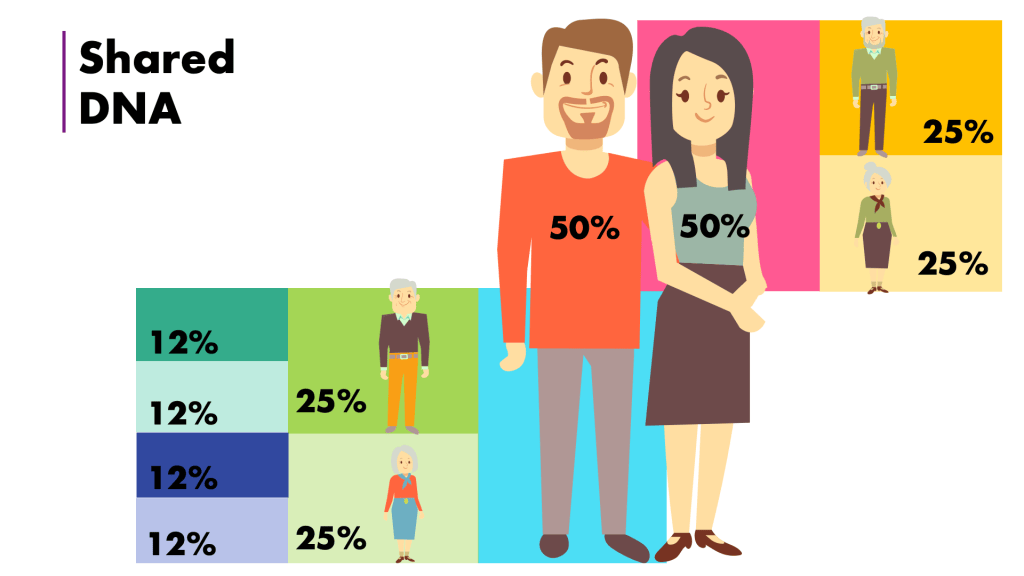
Most consumer DNA testing for genealogy starts with autosomal DNA. You got exactly 50% of your autosomal DNA from your mom and 50% from your dad. Past that, the math stops being so tidy.
You have a theoretical 25% from each grandparent, but in practice you may inherit more from one grandparent and less from another. It will still total 50% from each parent; it just isn’t divided evenly among the generations before them.
Picture every genealogy binder your family has ever assembled. Now dump all those pages into one big garbage bag. Reach in, pull out half at random, and hand them to your child. The other half? Gone.
That’s essentially what happens with DNA inheritance at every generation. It’s not a filing system. It’s a random draw, repeated over and over.
The result is important: as you move farther back in your family tree, there are real, fully documented ancestors from whom you may have inherited no detectable autosomal DNA at all. They are still your ancestors. Your DNA simply isn’t a complete archive of your family tree.
DNA Companies Don’t Measure Your Ancestors – They Measure Your Cousins
A testing company can’t directly measure the DNA you inherited from a long-deceased ancestor. What it measures is the DNA you share with living cousins – DNA you both happened to inherit from a common ancestor.
And the farther away the cousin relationship, the less certain it becomes that the two of you will share detectable DNA: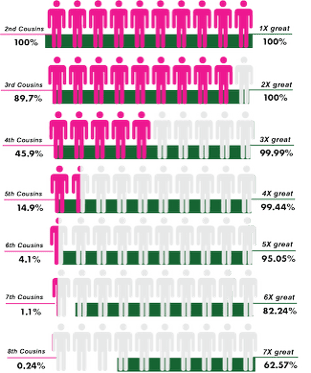
- Second cousins: you’ll share DNA essentially 100% of the time.
- Third cousins: about 90% of the time.
- Fourth cousins: only about 46% of the time.
- Sixth cousins: roughly 4% of the time.
So if you tested ten documented fourth cousins, you might match only about five of them. A missing DNA match does not automatically mean the genealogy is wrong.
This is also why testing siblings and other close relatives matters. Every relative who tests is another chance to capture a piece of your family’s DNA that you may not personally carry.
What About Half-Cousins and ‘Removed’ Cousins?
Half relationships and removed relationships reduce the expected amount of shared DNA. A half-second cousin, for example, behaves genetically more like a third cousin than a full second cousin. A second cousin once removed also has lower matching odds than a full second cousin. So if a documented half-cousin or once-removed cousin doesn’t appear in your match list, that alone isn’t necessarily a red flag. Understanding the generation of connection can also help you make sense of these relationships and what you should expect from the DNA.
What Autosomal DNA Can Prove
There’s a proof spectrum for what autosomal DNA alone can establish about a relationship, and it’s narrower than many people assume:
- Defined: Parent-child and full-sibling relationships can generally be clearly identified from DNA alone.
- Delimited: Half-siblings, grandparents, aunts/uncles, nieces/nephews and similar close relationships can often be narrowed to a small group of possibilities, but DNA alone may not identify the exact relationship.
- Hypothesized: Beyond those close relationships, shared DNA can support a possible relationship, but it cannot define the relationship by itself.
Trying to figure out how a DNA match might be related to you? The amount of DNA you share can help narrow the possibilities.
The Real Power: Checking Genetics Against Genealogy
Where DNA really earns its keep is when you compare the genetic evidence with the genealogy you’ve already built.
Take my friend Ed. His family tree is rooted in New England for generations, with one Portuguese line. When he found a DNA match who descended from that same Portuguese couple, he could ask two separate questions:
- Does the genealogy say we’re cousins?
- Does the amount of shared DNA fit that relationship?
That’s what we call checking genetics versus genealogy. When the documentary trail and the DNA evidence agree, your case gets much stronger.
What DNA Can Find That Paper Records Can’t
DNA can also surface relationships you had no way to document because there was nothing in the records to find. A close match can reveal an unknown half-sibling, parent, or child. It can also provide the clue that finally breaks through a long-standing brick wall.
One DNA Skills Workshop graduate, Anne, had a Polish branch of her tree that wouldn’t budge. She tried something simple: searching her MyHeritage match list by surname. She found a match with that Polish surname in the match’s tree, checked the genetics against the genealogy, and confirmed a third cousin once removed she hadn’t found through the paper trail alone.
Sometimes a simple surname search is enough to give you the clue that moves your research forward. The real skill is knowing which clue to pursue and how to test it against both the genetic and genealogical evidence.
Why Testing Other Family Members Matters
Your DNA test isn’t a complete genetic archive of your family. It’s one sample.
A sibling is another sample. Testing a parent or another older generation can be even more valuable. An aunt, uncle, cousin, or older relative may preserve DNA from an ancestor that didn’t make it down to you.
So don’t just ask, “Where should I test?” Ask, “Who should I test?”
If you’re working on a specific family-history mystery, targeted DNA testing can help you identify which relative is most likely to carry the DNA evidence you need.
Where You Test Still Matters
Once you understand what autosomal DNA can, and can’t, tell you, there’s another practical question: where should you test?
I evaluate DNA testing companies using three things:
- People: Does the database contain the relatives you need? A larger database gives you more chances, but different companies also reach different populations.
- Trees: Can you figure out who your matches are and where your families connect?
- Tools: Does the company give you the tools you need to investigate those relationships? Shared matches are essential, and shared-matches-of-matches tools can make useful family networks easier to see.
There’s no single “best” company for every research question. For a full comparison of the major testing companies – including their people, trees, tools, transfer options, and specialized strengths – see our Best DNA Test for Genealogy guide.
But remember: who you test can matter just as much as where you test. A sibling, aunt, uncle, or cousin may carry DNA from an ancestor that you don’t.
DNA Isn’t Your Family Tree. It’s Evidence for Your Family Tree.
DNA can’t tell you your whole family story, and it doesn’t replace traditional genealogy. It gives you a different kind of evidence.
DNA may tell you that two people are genetically connected. Genealogy helps you determine how. DNA may point toward one branch of your family. Records, trees, locations, names, and relationships help you follow that branch back to the ancestor you’re trying to find.
The question isn’t “Should I use DNA or traditional genealogy?” You should use both.
Because when you’re trying to solve a family-history mystery, genetics and genealogy really are better together.
Ready to Put This Into Practice?
Knowing what DNA can tell you is one thing. Knowing what to do next with your matches is the skill that moves your research forward.
That’s what we teach step by step inside the DNA Skills Workshop. 
Learn more about the DNA Skills Workshop
In the meantime, try one thing from this article: test another relative, search your matches for an important surname, or check whether the DNA supports a relationship you’ve already documented.

